

xradar furuno backend#
In this example, we read scn/scnx (furuno) data files using the xradar furuno xarray backend.
[1]:
import glob
import gzip
import io
import wradlib as wrl
import warnings

warnings.filterwarnings("ignore")
import matplotlib.pyplot as plt
import numpy as np
import xradar as xd
import xarray as xr

try:
    get_ipython().run_line_magic("matplotlib inline")
except:
    plt.ion()
Load furuno scn Data#
Data provided by University of Graz, Austria.
[2]:
fpath = "furuno/0080_20210730_160000_01_02.scn.gz"
f = wrl.util.get_wradlib_data_file(fpath)
vol = xd.io.open_furuno_datatree(f, reindex_angle=False)
Downloading file 'furuno/0080_20210730_160000_01_02.scn.gz' from 'https://github.com/wradlib/wradlib-data/raw/pooch/data/furuno/0080_20210730_160000_01_02.scn.gz' to '/home/runner/work/wradlib-notebooks/wradlib-notebooks/wradlib-data'.
Inspect RadarVolume#
[3]:
display(vol)
<xarray.DatasetView> Size: 248B
Dimensions:              (sweep: 1)
Dimensions without coordinates: sweep
Data variables:
    volume_number        int64 8B 0
    platform_type        <U5 20B 'fixed'
    instrument_type      <U5 20B 'radar'
    time_coverage_start  <U20 80B '2021-07-30T16:00:00Z'
    time_coverage_end    <U20 80B '2021-07-30T16:00:14Z'
    longitude            float64 8B 15.45
    altitude             float64 8B 407.9
    latitude             float64 8B 47.08
    sweep_fixed_angle    (sweep) float64 8B 7.8
    sweep_group_name     (sweep) int64 8B 0
Attributes:
    Conventions:      None
    instrument_name:  None
    version:          3
    title:            None
    institution:      None
    references:       None
    source:           Furuno
    history:          None
comment: im/exported using xradarInspect root group#
The sweep dimension contains the number of scans in this radar volume. Further the dataset consists of variables (location coordinates, time_coverage) and attributes (Conventions, metadata).
[4]:
vol.root
[4]:
<xarray.DatasetView> Size: 248B
Dimensions: (sweep: 1)
Dimensions without coordinates: sweep
Data variables:
volume_number int64 8B 0
platform_type <U5 20B 'fixed'
instrument_type <U5 20B 'radar'
time_coverage_start <U20 80B '2021-07-30T16:00:00Z'
time_coverage_end <U20 80B '2021-07-30T16:00:14Z'
longitude float64 8B 15.45
altitude float64 8B 407.9
latitude float64 8B 47.08
sweep_fixed_angle (sweep) float64 8B 7.8
sweep_group_name (sweep) int64 8B 0
Attributes:
Conventions: None
instrument_name: None
version: 3
title: None
institution: None
references: None
source: Furuno
history: None
comment: im/exported using xradarInspect sweep group(s)#
The sweep-groups can be accessed via their respective keys. The dimensions consist of range and time with added coordinates azimuth, elevation, range and time. There will be variables like radar moments (DBZH etc.) and sweep-dependend metadata (like fixed_angle, sweep_mode etc.).
[5]:
display(vol["sweep_0"])
<xarray.DatasetView> Size: 55MB
Dimensions:            (sweep: 1, azimuth: 1376, range: 602)
Coordinates:
    elevation          (azimuth) float64 11kB ...
  * range              (range) float32 2kB 25.0 75.0 ... 3.002e+04 3.008e+04
    time               (azimuth) datetime64[ns] 11kB 2021-07-30T16:00:06.2777...
    longitude          float64 8B ...
    latitude           float64 8B ...
    altitude           float64 8B ...
  * azimuth            (azimuth) float64 11kB 0.21 0.47 0.74 ... 359.7 359.9
Dimensions without coordinates: sweep
Data variables: (12/14)
    RATE               (azimuth, range) float64 7MB ...
    DBZH               (azimuth, range) float64 7MB ...
    VRADH              (azimuth, range) float64 7MB ...
    ZDR                (azimuth, range) float64 7MB ...
    KDP                (azimuth, range) float64 7MB ...
    PHIDP              (azimuth, range) float64 7MB ...
    ...                 ...
    QUAL               (azimuth, range) uint16 2MB ...
    sweep_mode         <U20 80B ...
    sweep_number       int64 8B ...
    prt_mode           <U7 28B ...
    follow_mode        <U7 28B ...
sweep_fixed_angle float64 8B ...Georeferencing#
[6]:
swp = vol["sweep_0"].ds.copy()
swp = swp.assign_coords(sweep_mode=swp.sweep_mode)
swp = swp.wrl.georef.georeference()
Inspect radar moments#
The DataArrays can be accessed by key or by attribute. Each DataArray has dimensions and coordinates of it’s parent dataset.
[7]:
display(swp.DBZH)
<xarray.DataArray 'DBZH' (azimuth: 1376, range: 602)> Size: 7MB
[828352 values with dtype=float64]
Coordinates: (12/15)
    sweep_mode  <U20 80B 'azimuth_surveillance'
    elevation   (azimuth) float64 11kB 7.8 7.8 7.8 7.8 7.8 ... 7.8 7.8 7.8 7.8
  * range       (range) float32 2kB 25.0 75.0 125.0 ... 3.002e+04 3.008e+04
    time        (azimuth) datetime64[ns] 11kB 2021-07-30T16:00:06.277723500 ....
    longitude   float64 8B 15.45
    latitude    float64 8B 47.08
    ...          ...
    y           (azimuth, range) float64 7MB 24.77 74.3 ... 2.973e+04 2.978e+04
    z           (azimuth, range) float64 7MB 411.3 418.1 ... 4.535e+03 4.542e+03
    gr          (azimuth, range) float64 7MB 24.77 74.3 ... 2.973e+04 2.978e+04
    rays        (azimuth, range) float64 7MB 0.21 0.21 0.21 ... 359.9 359.9
    bins        (azimuth, range) float32 3MB 25.0 75.0 ... 3.002e+04 3.008e+04
    crs_wkt     int64 8B 0
Attributes:
    long_name:      Equivalent reflectivity factor H
    units:          dBZ
standard_name: radar_equivalent_reflectivity_factor_hCreate simple plot#
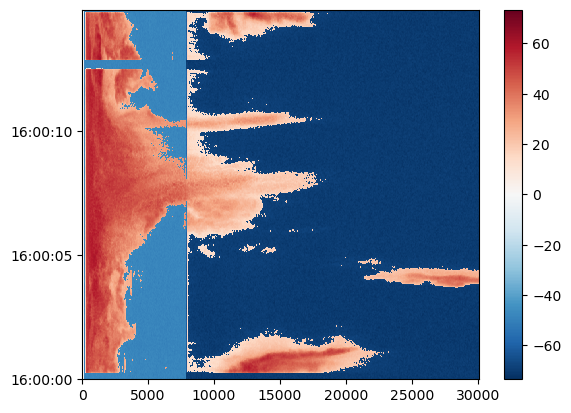
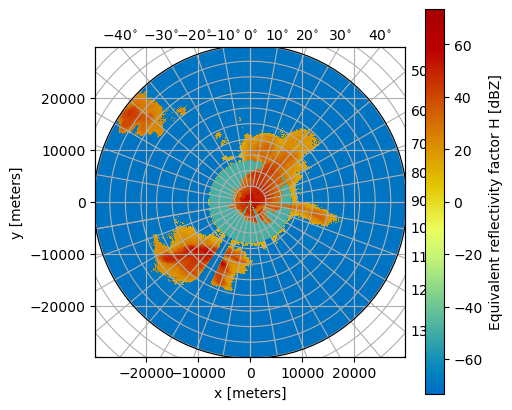
Using xarray features a simple plot can be created like this. Note the sortby('time') method, which sorts the radials by time.
For more details on plotting radar data see under Visualization.
[8]:
swp.DBZH.sortby("time").plot(x="range", y="time", add_labels=False)
[8]:
<matplotlib.collections.QuadMesh at 0x7ff0e052ec90>
[9]:
fig = plt.figure(figsize=(5, 5))
pm = swp.DBZH.wrl.vis.plot(crs={"latmin": 3e3}, fig=fig)
Use xr.open_dataset to retrieve explicit group#
Load furuno scnx Data#
Data provided by GFZ German Research Centre for Geosciences.
[10]:
fpath = "furuno/2006_20220324_000000_000.scnx.gz"
f = wrl.util.get_wradlib_data_file(fpath)
vol = xd.io.open_furuno_datatree(f, reindex_angle=False)
Downloading file 'furuno/2006_20220324_000000_000.scnx.gz' from 'https://github.com/wradlib/wradlib-data/raw/pooch/data/furuno/2006_20220324_000000_000.scnx.gz' to '/home/runner/work/wradlib-notebooks/wradlib-notebooks/wradlib-data'.
Inspect RadarVolume#
[11]:
display(vol)
<xarray.DatasetView> Size: 248B
Dimensions:              (sweep: 1)
Dimensions without coordinates: sweep
Data variables:
    volume_number        int64 8B 0
    platform_type        <U5 20B 'fixed'
    instrument_type      <U5 20B 'radar'
    time_coverage_start  <U20 80B '2022-03-24T00:00:01Z'
    time_coverage_end    <U20 80B '2022-03-24T00:00:28Z'
    longitude            float64 8B 13.24
    altitude             float64 8B 38.0
    latitude             float64 8B 53.55
    sweep_fixed_angle    (sweep) float64 8B 0.5
    sweep_group_name     (sweep) int64 8B 0
Attributes:
    Conventions:      None
    instrument_name:  None
    version:          10
    title:            None
    institution:      None
    references:       None
    source:           Furuno
    history:          None
comment: im/exported using xradarInspect root group#
The sweep dimension contains the number of scans in this radar volume. Further the dataset consists of variables (location coordinates, time_coverage) and attributes (Conventions, metadata).
[12]:
vol.root
[12]:
<xarray.DatasetView> Size: 248B
Dimensions: (sweep: 1)
Dimensions without coordinates: sweep
Data variables:
volume_number int64 8B 0
platform_type <U5 20B 'fixed'
instrument_type <U5 20B 'radar'
time_coverage_start <U20 80B '2022-03-24T00:00:01Z'
time_coverage_end <U20 80B '2022-03-24T00:00:28Z'
longitude float64 8B 13.24
altitude float64 8B 38.0
latitude float64 8B 53.55
sweep_fixed_angle (sweep) float64 8B 0.5
sweep_group_name (sweep) int64 8B 0
Attributes:
Conventions: None
instrument_name: None
version: 10
title: None
institution: None
references: None
source: Furuno
history: None
comment: im/exported using xradarInspect sweep group(s)#
The sweep-groups can be accessed via their respective keys. The dimensions consist of range and time with added coordinates azimuth, elevation, range and time. There will be variables like radar moments (DBZH etc.) and sweep-dependend metadata (like fixed_angle, sweep_mode etc.).
[13]:
display(vol["sweep_0"])
<xarray.DatasetView> Size: 45MB
Dimensions:            (sweep: 1, azimuth: 722, range: 936)
Coordinates:
    elevation          (azimuth) float64 6kB ...
  * range              (range) float32 4kB 37.5 112.5 ... 7.009e+04 7.016e+04
    time               (azimuth) datetime64[ns] 6kB 2022-03-24T00:00:17.65643...
    longitude          float64 8B ...
    latitude           float64 8B ...
    altitude           float64 8B ...
  * azimuth            (azimuth) float64 6kB 0.19 0.68 1.16 ... 359.2 359.7
Dimensions without coordinates: sweep
Data variables: (12/14)
    RATE               (azimuth, range) float64 5MB ...
    DBZH               (azimuth, range) float64 5MB ...
    VRADH              (azimuth, range) float64 5MB ...
    ZDR                (azimuth, range) float64 5MB ...
    KDP                (azimuth, range) float64 5MB ...
    PHIDP              (azimuth, range) float64 5MB ...
    ...                 ...
    QUAL               (azimuth, range) uint16 1MB ...
    sweep_mode         <U20 80B ...
    sweep_number       int64 8B ...
    prt_mode           <U7 28B ...
    follow_mode        <U7 28B ...
sweep_fixed_angle float64 8B ...Georeferencing#
[14]:
swp = vol["sweep_0"].ds.copy()
swp = swp.assign_coords(sweep_mode=swp.sweep_mode)
swp = swp.wrl.georef.georeference()
Inspect radar moments#
The DataArrays can be accessed by key or by attribute. Each DataArray has dimensions and coordinates of it’s parent dataset.
[15]:
display(swp.DBZH)
<xarray.DataArray 'DBZH' (azimuth: 722, range: 936)> Size: 5MB
[675792 values with dtype=float64]
Coordinates: (12/15)
    sweep_mode  <U20 80B 'azimuth_surveillance'
    elevation   (azimuth) float64 6kB 0.5 0.5 0.5 0.5 0.5 ... 0.5 0.5 0.5 0.5
  * range       (range) float32 4kB 37.5 112.5 187.5 ... 7.009e+04 7.016e+04
    time        (azimuth) datetime64[ns] 6kB 2022-03-24T00:00:17.656439500 .....
    longitude   float64 8B 13.24
    latitude    float64 8B 53.55
    ...          ...
    y           (azimuth, range) float64 5MB 37.5 112.5 ... 7.008e+04 7.015e+04
    z           (azimuth, range) float64 5MB 38.33 38.98 39.64 ... 939.0 940.3
    gr          (azimuth, range) float64 5MB 37.53 112.5 ... 7.008e+04 7.015e+04
    rays        (azimuth, range) float64 5MB 0.19 0.19 0.19 ... 359.7 359.7
    bins        (azimuth, range) float32 3MB 37.5 112.5 ... 7.009e+04 7.016e+04
    crs_wkt     int64 8B 0
Attributes:
    long_name:      Equivalent reflectivity factor H
    units:          dBZ
standard_name: radar_equivalent_reflectivity_factor_hCreate simple plot#
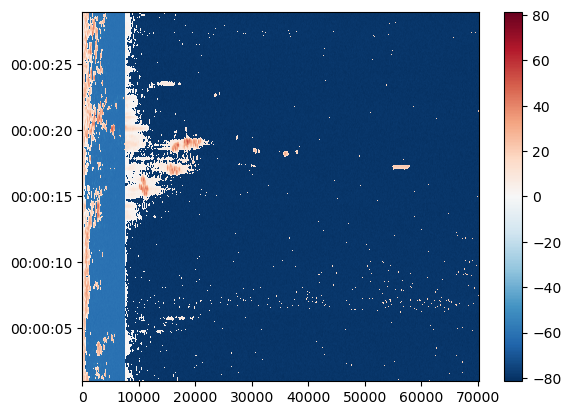
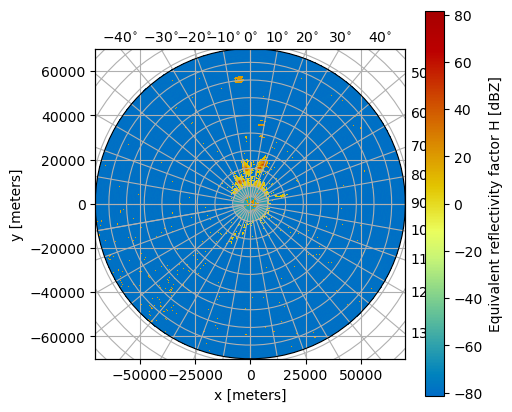
Currently the data dynamic range is left as read from the file. That way the difference between shortpulse and longpulse can be clearly seen.
Using xarray features a simple plot can be created like this. Note the sortby('time') method, which sorts the radials by time.
For more details on plotting radar data see under Visualization.
[16]:
swp.DBZH.sortby("time").plot(x="range", y="time", add_labels=False)
[16]:
<matplotlib.collections.QuadMesh at 0x7ff0df06b5f0>
[17]:
fig = plt.figure(figsize=(5, 5))
pm = swp.DBZH.wrl.vis.plot(crs={"latmin": 3e3}, fig=fig)
More Furuno loading mechanisms#
Use xr.open_dataset to retrieve explicit group#
[18]:
swp_b = xr.open_dataset(f, engine="furuno", backend_kwargs=dict(reindex_angle=False))
display(swp_b)
<xarray.Dataset> Size: 45MB
Dimensions:            (azimuth: 722, range: 936)
Coordinates:
    elevation          (azimuth) float64 6kB ...
  * range              (range) float32 4kB 37.5 112.5 ... 7.009e+04 7.016e+04
    time               (azimuth) datetime64[ns] 6kB ...
    longitude          float64 8B ...
    latitude           float64 8B ...
    altitude           float64 8B ...
  * azimuth            (azimuth) float64 6kB 0.19 0.68 1.16 ... 359.2 359.7
Data variables: (12/14)
    RATE               (azimuth, range) float64 5MB ...
    DBZH               (azimuth, range) float64 5MB ...
    VRADH              (azimuth, range) float64 5MB ...
    ZDR                (azimuth, range) float64 5MB ...
    KDP                (azimuth, range) float64 5MB ...
    PHIDP              (azimuth, range) float64 5MB ...
    ...                 ...
    QUAL               (azimuth, range) uint16 1MB ...
    sweep_mode         <U20 80B ...
    sweep_number       int64 8B ...
    prt_mode           <U7 28B ...
    follow_mode        <U7 28B ...
    sweep_fixed_angle  float64 8B ...
Attributes:
    source:                     Furuno
    version:                    10
    antenna_gain_h:             337
    antenna_gain_v:             338
    tx_power_h:                 724
    tx_power_v:                 708
    radar_constant_h:           -1294
    radar_constant_v:           -1296
    noise_power_short_pulse_h:  -604