xarray IRIS backend
In this example, we read IRIS (sigmet) data files using the wradlib iris xarray backend.
[1]:
import glob
import gzip
import io
import wradlib as wrl
import warnings
warnings.filterwarnings('ignore')
import matplotlib.pyplot as pl
import numpy as np
import xarray as xr
try:
    get_ipython().magic("matplotlib inline")
except:
    pl.ion()
Load IRIS Volume Data
[2]:
fpath = 'sigmet/SUR210819000227.RAWKPJV'
f = wrl.util.get_wradlib_data_file(fpath)
vol = wrl.io.open_iris_dataset(f, reindex_angle=False)
Inspect RadarVolume
[3]:
display(vol)
<wradlib.RadarVolume>
Dimension(s): (sweep: 1)
Elevation(s): (0.5)
Inspect root group
The sweep dimension contains the number of scans in this radar volume. Further the dataset consists of variables (location coordinates, time_coverage) and attributes (Conventions, metadata).
[4]:
vol.root
[4]:
<xarray.Dataset>
Dimensions:              (sweep: 1)
Coordinates:
    time                 datetime64[ns] 2021-08-19T00:02:27.432000
    longitude            float64 25.52
    altitude             float64 157.0
    sweep_mode           <U20 'azimuth_surveillance'
    latitude             float64 58.48
Dimensions without coordinates: sweep
Data variables:
    volume_number        int64 0
    platform_type        <U5 'fixed'
    instrument_type      <U5 'radar'
    primary_axis         <U6 'axis_z'
    time_coverage_start  <U20 '2021-08-19T00:02:28Z'
    time_coverage_end    <U20 '2021-08-19T00:02:49Z'
    sweep_group_name     (sweep) <U7 'sweep_0'
    sweep_fixed_angle    (sweep) float64 0.5
Attributes:
    version:          None
    title:            None
    institution:      None
    references:       None
    source:           None
    history:          None
    comment:          im/exported using wradlib
    instrument_name:  None
fixed_angle: 0.5Inspect sweep group(s)
The sweep-groups can be accessed via their respective keys. The dimensions consist of range and time with added coordinates azimuth, elevation, range and time. There will be variables like radar moments (DBZH etc.) and sweep-dependend metadata (like fixed_angle, sweep_mode etc.).
[5]:
display(vol[0])
<xarray.Dataset>
Dimensions:     (azimuth: 359, range: 833)
Coordinates:
  * azimuth     (azimuth) float32 0.03021 1.035 2.054 ... 357.0 358.0 359.0
    elevation   (azimuth) float64 0.5054 0.5054 0.5054 ... 0.5054 0.5054 0.5054
    rtime       (azimuth) datetime64[ns] 2021-08-19T00:02:31.104000 ... 2021-...
    time        datetime64[ns] 2021-08-19T00:02:27.432000
  * range       (range) float32 150.0 450.0 750.0 ... 2.494e+05 2.498e+05
    longitude   float64 25.52
    latitude    float64 58.48
    altitude    float64 157.0
    sweep_mode  <U20 'azimuth_surveillance'
Data variables:
    DB_XHDR     (azimuth, range) object ...
    DBTH        (azimuth, range) float32 ...
    DBZH        (azimuth, range) float32 ...
    VRADH       (azimuth, range) float32 ...
    WRADH       (azimuth, range) float32 ...
    ZDR         (azimuth, range) float32 ...
    KDP         (azimuth, range) float32 ...
    RHOHV       (azimuth, range) float32 ...
    SQIH        (azimuth, range) float32 ...
    PHIDP       (azimuth, range) float32 ...
    DB_HCLASS2  (azimuth, range) int16 ...
    SNRH        (azimuth, range) float32 ...
Attributes:
fixed_angle: 0.5Goereferencing
[6]:
swp = vol[0].copy().pipe(wrl.georef.georeference_dataset)
Plotting
[7]:
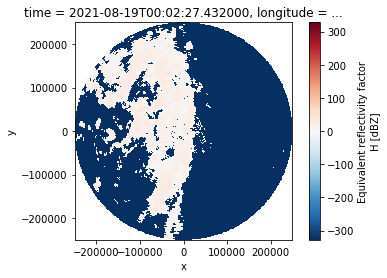
swp.DBZH.plot.pcolormesh(x='x', y='y')
pl.gca().set_aspect('equal')
[8]:
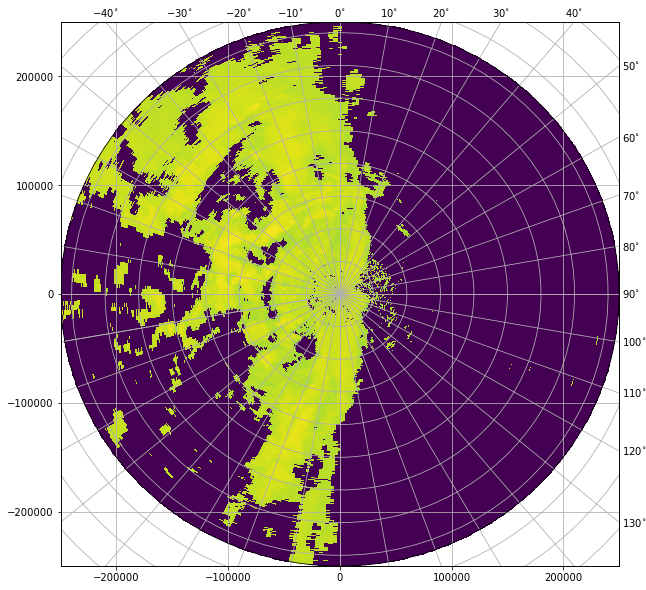
fig = pl.figure(figsize=(10,10))
swp.DBZH.wradlib.plot_ppi(proj='cg', fig=fig)
[8]:
<matplotlib.collections.QuadMesh at 0x7f66a0f5ae30>
[9]:
import cartopy
import cartopy.crs as ccrs
import cartopy.feature as cfeature

map_trans = ccrs.AzimuthalEquidistant(central_latitude=swp.latitude.values,
                                      central_longitude=swp.longitude.values)
[10]:
map_proj = ccrs.AzimuthalEquidistant(central_latitude=swp.latitude.values,
                                      central_longitude=swp.longitude.values)
pm = swp.DBZH.wradlib.plot_ppi(proj=map_proj)
ax = pl.gca()
ax.gridlines(crs=map_proj)
print(ax)
< GeoAxes: +proj=aeqd +ellps=WGS84 +lon_0=25.518660116940737 +lat_0=58.48231002688408 +x_0=0.0 +y_0=0.0 +no_defs +type=crs >
[11]:
map_proj = ccrs.Mercator(central_longitude=swp.longitude.values)
fig = pl.figure(figsize=(10,8))
ax = fig.add_subplot(111, projection=map_proj)
pm = swp.DBZH.wradlib.plot_ppi(ax=ax)
ax.gridlines(draw_labels=True)
[11]:
<cartopy.mpl.gridliner.Gridliner at 0x7f66a0c28a90>

[12]:
import cartopy.feature as cfeature
def plot_borders(ax):
    borders = cfeature.NaturalEarthFeature(category='physical',
                                           name='coastline',
                                           scale='10m',
                                           facecolor='none')
    ax.add_feature(borders, edgecolor='black', lw=2, zorder=4)

map_proj = ccrs.Mercator(central_longitude=swp.longitude.values)
fig = pl.figure(figsize=(10,8))
ax = fig.add_subplot(111, projection=map_proj)

DBZH = swp.DBZH
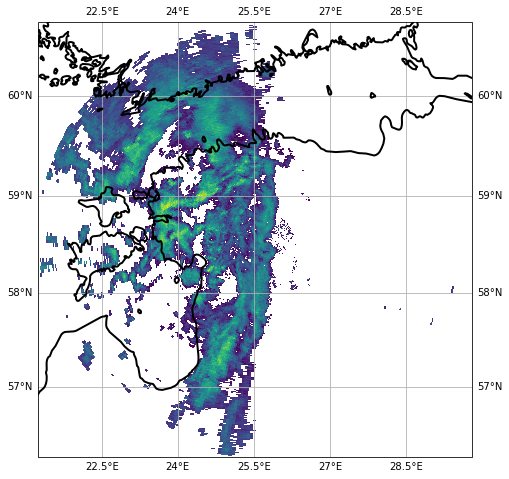
pm = DBZH.where(DBZH > 0).wradlib.plot_ppi(ax=ax)
plot_borders(ax)
ax.gridlines(draw_labels=True)
[12]:
<cartopy.mpl.gridliner.Gridliner at 0x7f66a0c962f0>
[13]:
import matplotlib.path as mpath
theta = np.linspace(0, 2*np.pi, 100)
center, radius = [0.5, 0.5], 0.5
verts = np.vstack([np.sin(theta), np.cos(theta)]).T
circle = mpath.Path(verts * radius + center)

map_proj = ccrs.AzimuthalEquidistant(central_latitude=swp.latitude.values,
                                     central_longitude=swp.longitude.values,
                                    )
fig = pl.figure(figsize=(10,8))
ax = fig.add_subplot(111, projection=map_proj)
ax.set_boundary(circle, transform=ax.transAxes)

pm = swp.DBZH.wradlib.plot_ppi(proj=map_proj, ax=ax)
ax = pl.gca()
ax.gridlines(crs=map_proj)
[13]:
<cartopy.mpl.gridliner.Gridliner at 0x7f66a091c310>

[14]:
fig = pl.figure(figsize=(10, 8))
proj=ccrs.AzimuthalEquidistant(central_latitude=swp.latitude.values,
                               central_longitude=swp.longitude.values)
ax = fig.add_subplot(111, projection=proj)
pm = swp.DBZH.wradlib.plot_ppi(ax=ax)
ax.gridlines()
[14]:
<cartopy.mpl.gridliner.Gridliner at 0x7f66a0de0eb0>
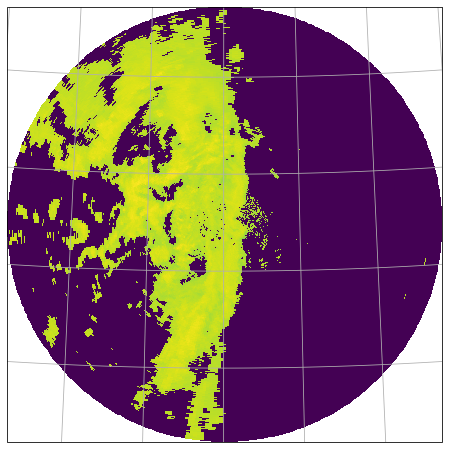
[15]:
swp.DBZH.wradlib.plot_ppi()
[15]:
<matplotlib.collections.QuadMesh at 0x7f66a0e72230>
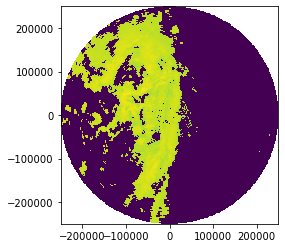
Inspect radar moments
The DataArrays can be accessed by key or by attribute. Each DataArray has dimensions and coordinates of it’s parent dataset.
[16]:
display(swp.DBZH)
<xarray.DataArray 'DBZH' (azimuth: 359, range: 833)>
array([[-327.68, -327.68, -327.68, ..., -327.68, -327.68, -327.68],
       [-327.68,    3.39,    6.45, ..., -327.68, -327.68, -327.68],
       [  -8.86,    5.25,    8.58, ..., -327.68, -327.68, -327.68],
       ...,
       [-327.68, -327.68, -327.68, ..., -327.68, -327.68, -327.68],
       [-327.68,    4.75,   10.95, ..., -327.68, -327.68, -327.68],
       [-327.68, -327.68,    4.94, ..., -327.68, -327.68, -327.68]])
Coordinates: (12/15)
  * azimuth     (azimuth) float32 0.03021 1.035 2.054 ... 357.0 358.0 359.0
    elevation   (azimuth) float64 0.5054 0.5054 0.5054 ... 0.5054 0.5054 0.5054
    rtime       (azimuth) datetime64[ns] 2021-08-19T00:02:31.104000 ... 2021-...
    time        datetime64[ns] 2021-08-19T00:02:27.432000
  * range       (range) float32 150.0 450.0 750.0 ... 2.494e+05 2.498e+05
    longitude   float64 25.52
    ...          ...
    x           (azimuth, range) float64 0.0791 0.2373 ... -4.206e+03 -4.211e+03
    y           (azimuth, range) float64 150.0 450.0 ... 2.493e+05 2.496e+05
    z           (azimuth, range) float64 158.3 161.0 ... 6.023e+03 6.034e+03
    gr          (azimuth, range) float64 150.0 450.0 ... 2.493e+05 2.496e+05
    rays        (azimuth, range) float32 0.03021 0.03021 0.03021 ... 359.0 359.0
    bins        (azimuth, range) float32 150.0 450.0 ... 2.494e+05 2.498e+05
Attributes:
    long_name:      Equivalent reflectivity factor H
    standard_name:  radar_equivalent_reflectivity_factor_h
units: dBZCreate simple plot
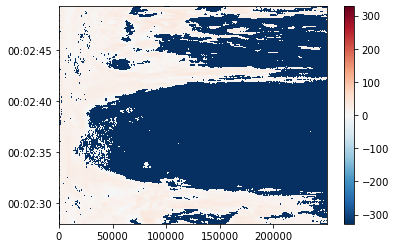
Using xarray features a simple plot can be created like this. Note the sortby('rtime') method, which sorts the radials by time.
[17]:
swp.DBZH.sortby('rtime').plot(x="range", y="rtime", add_labels=False)
[17]:
<matplotlib.collections.QuadMesh at 0x7f66a100a560>
[18]:
fig = pl.figure(figsize=(5,5))
pm = swp.DBZH.wradlib.plot_ppi(proj={'latmin': 3e3}, fig=fig)

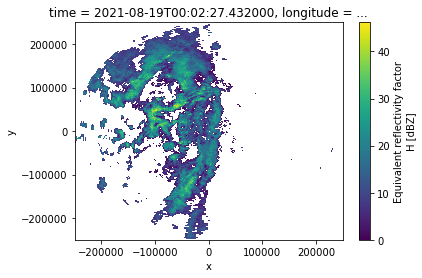
Mask some values
[19]:
dbzh = swp['DBZH'].where(swp['DBZH'] >= 0)
dbzh.plot(x="x", y="y")
[19]:
<matplotlib.collections.QuadMesh at 0x7f669cd35bd0>
[20]:
vol[0]
[20]:
<xarray.Dataset>
Dimensions:     (azimuth: 359, range: 833)
Coordinates:
  * azimuth     (azimuth) float32 0.03021 1.035 2.054 ... 357.0 358.0 359.0
    elevation   (azimuth) float64 0.5054 0.5054 0.5054 ... 0.5054 0.5054 0.5054
    rtime       (azimuth) datetime64[ns] 2021-08-19T00:02:31.104000 ... 2021-...
    time        datetime64[ns] 2021-08-19T00:02:27.432000
  * range       (range) float32 150.0 450.0 750.0 ... 2.494e+05 2.498e+05
    longitude   float64 25.52
    latitude    float64 58.48
    altitude    float64 157.0
    sweep_mode  <U20 'azimuth_surveillance'
Data variables:
    DB_XHDR     (azimuth, range) object ...
    DBTH        (azimuth, range) float32 ...
    DBZH        (azimuth, range) float32 ...
    VRADH       (azimuth, range) float32 ...
    WRADH       (azimuth, range) float32 ...
    ZDR         (azimuth, range) float32 ...
    KDP         (azimuth, range) float32 ...
    RHOHV       (azimuth, range) float32 ...
    SQIH        (azimuth, range) float32 ...
    PHIDP       (azimuth, range) float32 ...
    DB_HCLASS2  (azimuth, range) int16 ...
    SNRH        (azimuth, range) float32 ...
Attributes:
fixed_angle: 0.5Export to ODIM and CfRadial2
Need to remove DB_XHDR since it can’t be represented as ODIM/CfRadial2 moment.
[21]:
vol[0] = vol[0].drop("DB_XHDR", errors="ignore")
vol[0].DBZH.sortby("rtime").plot(y="rtime")
[21]:
<matplotlib.collections.QuadMesh at 0x7f669cd8c370>

[22]:
vol.to_odim('iris_as_odim.h5')
vol.to_cfradial2('iris_as_cfradial2.nc')
Import again
[23]:
vola = wrl.io.open_odim_dataset('iris_as_odim.h5', reindex_angle=False, keep_elevation=True)
display(vola.root)
display(vola[0])
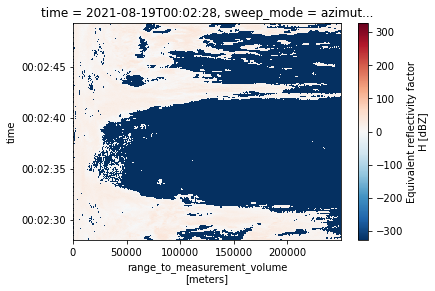
vola[0].DBZH.sortby("rtime").plot(y="rtime")
<xarray.Dataset>
Dimensions:              (sweep: 1)
Coordinates:
    time                 datetime64[ns] 2021-08-19T00:02:28
    sweep_mode           <U20 'azimuth_surveillance'
    longitude            float64 25.52
    altitude             float64 157.0
    latitude             float64 58.48
Dimensions without coordinates: sweep
Data variables:
    volume_number        int64 0
    platform_type        <U5 'fixed'
    instrument_type      <U5 'radar'
    primary_axis         <U6 'axis_z'
    time_coverage_start  <U20 '2021-08-19T00:02:28Z'
    time_coverage_end    <U20 '2021-08-19T00:02:49Z'
    sweep_group_name     (sweep) <U7 'sweep_0'
    sweep_fixed_angle    (sweep) float64 0.5
Attributes:
    version:          None
    title:            None
    institution:      None
    references:       None
    source:           None
    history:          None
    comment:          im/exported using wradlib
    instrument_name:  None
fixed_angle: 0.5<xarray.Dataset>
Dimensions: (azimuth: 359, range: 833)
Coordinates:
* azimuth (azimuth) float32 0.03021 1.035 2.054 ... 357.0 358.0 359.0
elevation (azimuth) float64 0.5054 0.5054 0.5054 ... 0.5054 0.5054 0.5054
rtime (azimuth) datetime64[ns] 2021-08-19T00:02:31.104000 ... 2021-...
* range (range) float32 150.0 450.0 750.0 ... 2.494e+05 2.498e+05
time datetime64[ns] 2021-08-19T00:02:28
sweep_mode <U20 'azimuth_surveillance'
longitude float64 25.52
latitude float64 58.48
altitude float64 157.0
Data variables:
DBTH (azimuth, range) float32 ...
SNRH (azimuth, range) float32 ...
DBZH (azimuth, range) float32 ...
VRADH (azimuth, range) float32 ...
WRADH (azimuth, range) float32 ...
ZDR (azimuth, range) float32 ...
KDP (azimuth, range) float32 ...
RHOHV (azimuth, range) float32 ...
SQIH (azimuth, range) float32 ...
PHIDP (azimuth, range) float32 ...
Attributes:
fixed_angle: 0.5[23]:
<matplotlib.collections.QuadMesh at 0x7f66a07c8880>
[24]:
volb = wrl.io.open_cfradial2_dataset('iris_as_cfradial2.nc')
display(volb.root)
display(volb[0])
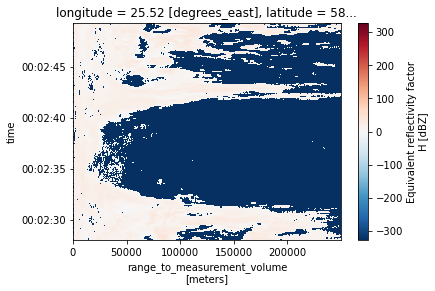
volb[0].DBZH.sortby("rtime").plot(y="rtime")
<xarray.Dataset>
Dimensions:              (sweep: 1)
Coordinates:
    longitude            float64 25.52
    altitude             float64 157.0
    sweep_mode           <U20 'azimuth_surveillance'
    time                 datetime64[ns] 2021-08-19T00:02:28
    latitude             float64 58.48
Dimensions without coordinates: sweep
Data variables:
    volume_number        int64 0
    platform_type        <U5 'fixed'
    instrument_type      <U5 'radar'
    primary_axis         <U6 'axis_z'
    time_coverage_start  <U20 '2021-08-19T00:02:28Z'
    time_coverage_end    <U20 '2021-08-19T00:02:49Z'
    sweep_group_name     (sweep) <U7 'sweep_0'
    sweep_fixed_angle    (sweep) float64 0.5
Attributes:
    version:          None
    title:            None
    institution:      None
    references:       None
    source:           None
    history:          None
    comment:          im/exported using wradlib
    instrument_name:  None
fixed_angle: 0.5<xarray.Dataset>
Dimensions: (azimuth: 359, range: 833)
Coordinates:
* azimuth (azimuth) float32 0.03021 1.035 2.054 ... 357.0 358.0 359.0
elevation (azimuth) float32 0.5054 0.5054 0.5054 ... 0.5054 0.5054 0.5054
rtime (azimuth) datetime64[ns] 2021-08-19T00:02:31.104000 ... 2021-...
* range (range) float32 150.0 450.0 750.0 ... 2.494e+05 2.498e+05
longitude float64 25.52
latitude float64 58.48
altitude float64 157.0
sweep_mode <U20 'azimuth_surveillance'
time datetime64[ns] 2021-08-19T00:02:28
Data variables:
DBTH (azimuth, range) float32 ...
DBZH (azimuth, range) float32 ...
VRADH (azimuth, range) float32 ...
WRADH (azimuth, range) float32 ...
ZDR (azimuth, range) float32 ...
KDP (azimuth, range) float32 ...
RHOHV (azimuth, range) float32 ...
SQIH (azimuth, range) float32 ...
PHIDP (azimuth, range) float32 ...
DB_HCLASS2 (azimuth, range) int16 ...
SNRH (azimuth, range) float32 ...
Attributes:
fixed_angle: 0.5[24]:
<matplotlib.collections.QuadMesh at 0x7f66a06520e0>
Check equality
We have to drop the time variable when checking equality since IRIS has millisecond resolution.
[25]:
xr.testing.assert_allclose(vol.root.drop("time"), vola.root.drop("time"))
xr.testing.assert_allclose(vol[0].drop(["rtime", "time", "DB_HCLASS2"]), vola[0].drop(["rtime", "time"]))
xr.testing.assert_allclose(vol.root.drop("time"), volb.root.drop("time"))
xr.testing.assert_allclose(vol[0].drop("time"), volb[0].drop("time"))
xr.testing.assert_allclose(vola.root, volb.root)
xr.testing.assert_allclose(vola[0].drop("rtime"), volb[0].drop(["rtime", "DB_HCLASS2"]))
More Iris loading mechanisms
Use xr.open_dataset to retrieve explicit group
[26]:
swp = xr.open_dataset(f, engine="iris", group=1, backend_kwargs=dict(reindex_angle=False))
display(swp)
<xarray.Dataset>
Dimensions:     (azimuth: 359, range: 833)
Coordinates:
  * azimuth     (azimuth) float32 0.03021 1.035 2.054 ... 357.0 358.0 359.0
    elevation   (azimuth) float64 0.5054 0.5054 0.5054 ... 0.5054 0.5054 0.5054
    rtime       (azimuth) datetime64[ns] 2021-08-19T00:02:31.104000 ... 2021-...
    time        datetime64[ns] 2021-08-19T00:02:27.432000
  * range       (range) float32 150.0 450.0 750.0 ... 2.494e+05 2.498e+05
    longitude   float64 25.52
    latitude    float64 58.48
    altitude    float64 157.0
    sweep_mode  <U20 'azimuth_surveillance'
Data variables:
    DB_XHDR     (azimuth, range) object ...
    DBTH        (azimuth, range) float32 ...
    DBZH        (azimuth, range) float32 ...
    VRADH       (azimuth, range) float32 ...
    WRADH       (azimuth, range) float32 ...
    ZDR         (azimuth, range) float32 ...
    KDP         (azimuth, range) float32 ...
    RHOHV       (azimuth, range) float32 ...
    SQIH        (azimuth, range) float32 ...
    PHIDP       (azimuth, range) float32 ...
    DB_HCLASS2  (azimuth, range) int16 ...
    SNRH        (azimuth, range) float32 ...
Attributes:
    fixed_angle:  0.5