This notebook is part of the \(\omega radlib\) documentation: https://docs.wradlib.org.
Copyright (c) \(\omega radlib\) developers. Distributed under the MIT License. See LICENSE.txt for more info.
Multi File OdimH5 reader
This implementation is based on several classes which are described below.
Class Overview
XRadBase
Implements collections.abc.MutableSequence for holding sequential data in the derived classes (eg. sweeps, timeseries, moments).
OdimH5GroupAttributeMixin
Implements properties for XRadMoment, XRadSweep, XRadTimeSeries and XRadVolume to nicely acquire ODIM group metadata, eg. how, what and where groups. Other wanted attributes can be acquired via attrs-property and other (sub-) groups be inspected via groups-property.
OdimH5SweepMetaDataMixin
Implements properties for XRadSweep to nicely acquire ODIM sweep metadata, eg. a1gate, azimuth, nrays, nbins etc.
XRadMoment
Uses OdimH5GroupAttributeMixin to access ODIM metadata. Does not hold any data. Property data fetches the moment as xarray DataArray from the parent XRadSweep.
XRadSweep
Inherits from XRadBase, uses OdimH5GroupAttributeMixin and OdimH5SweepMetaDataMixin. Worker class, where everything happens. Implements methods and properties to retrieve sweep metadata and data. Holds XRadMoments in it’s MutableSequence. Property data is used to load and cache the XRadMoments as combined xarray Dataset. Implements a whole arsenal of other properties to inspect metadata.
XRadSweepOdim:
Inherits from XRadSweep. Accounts for ODIM data layout.
XRadSweepGamic:
Inherits from XRadSweep. Accounts for GAMIC data layout.
XRadTimeSeries
Inherits from XRadBase, holds several XRadSweep objects in it’s MutableSequence. Property data is used to concat and cache the XRadSweeps as xarray Dataset along time dimension. Implements check methods to quickly get information about layout of timeseries data.
XRadVolume
Inherits from XRadBase, holds several XRadTimeSeries objects in it’s MutableSequence. Implements CfRadial2 like root property.
Loading Function
For opening ODIMH5 datafiles wrl.io.open_odim(filename, loader='h5py', **kwargs) can be used.
The user can decide which loader to use (h5py, h5netcdf or netcdf4) to open the files for reading. The output should be the same in any case, although the memory footprint can differ quite substantially. The default loader is netcdf4 if loader isn’t specified.
The datasets are retrieved in further succession via xarray.open_dataset() in combination with either xarray.backends.H5NetCDFStore (for loader h5py and h5netcdf) or xarray.backends.NetCDF4DataStore (for loader netcdf4.
Possible keyword arguments are:
mask_and_scalebool - If True, apply mask and scale to moment data arraysdecode_coordsbool - If True, decode ODIMH5 coordinatesdecode_timesbool - If True, decode times into datetime objectschunksint or dict - Data loaded as dask arrayparallelbool - if True, usedask.delayedto load moments in parallel
The user is encouraged to play with the keyword arguments for best alignment with the needs in terms of speed and performance.
[1]:
import wradlib as wrl
import warnings
warnings.filterwarnings('ignore')
import matplotlib.pyplot as pl
import numpy as np
import xarray as xr
import os
import glob
try:
    get_ipython().magic("matplotlib inline")
except:
    pl.ion()
[2]:
import os
import psutil
import gc
process = psutil.Process(os.getpid())
[3]:
def memory_usage_psutil():
    # return the memory usage in MB
    rocess = psutil.Process(os.getpid())
    mem = process.memory_full_info().uss / float(1 << 20)
    return mem
[4]:
def free_memory():
    mem0 = memory_usage_psutil()
    print(gc.collect())
    proc = psutil.Process()
    mem1 = memory_usage_psutil()
    print("Memory freed: {0:.5f} MB".format((mem0-mem1)))
[5]:
def check_open_files(full=False):
    proc = psutil.Process()
    print(len(proc.open_files()))
    if full:
        print(proc.open_files())
[6]:
fpath = wrl.util.get_wradlib_data_path()
f = os.path.join(fpath, 'hdf5/behel/20*.hdf')
[7]:
mem_start = memory_usage_psutil()
print("Current Memory:", mem_start)
Current Memory: 117.921875
Claim Files into class structure
The different files will be opened with h5netcdf, h5py or netcdf4 depending on loader keyword. Only absolutely neccessary metadata (time, elevation) is read from the files to be used for aligning into the structure.
Normally h5py is the most performant loader for ODIM data. But your mileage may vary.
This means that every file is opened once and the filehandle is distributed to XRadSweep. If XRadSweep will be destroyed, the memory will be ready for garbage collection.
Under the hood netcdf4 or h5netcdf will be used to open data as xarray.Dataset depending on the loader-type. All filehandling issues are moved to xarray. No memory holes, no need to track filehandles.
[9]:
%%time
vol = wrl.io.xarray.open_odim(f, loader='h5py', chunks={})
Open: 100%|██████████| 32/32 [00:00<00:00, 328.92 Files/s]
Collecting: 100%|██████████| 12/12 [00:00<00:00, 74.62 Angles/s]
CPU times: user 561 ms, sys: 28.4 ms, total: 590 ms
Wall time: 600 ms
Overview type and lenght
[11]:
print("Volume:", type(vol), len(vol))
print("TimeSeries:", type(vol[0]), len(vol[0]))
print("Sweep:", type(vol[0][0]), len(vol[0][0]))
print("Moment:", type(vol[0][0][0]), vol[0][0][0].quantity)
Volume: <class 'wradlib.io.xarray.XRadVolume'> 12
TimeSeries: <class 'wradlib.io.xarray.XRadTimeSeries'> 8
Sweep: <class 'wradlib.io.xarray.XRadSweepOdim'> 4
Moment: <class 'wradlib.io.xarray.XRadMoment'> WRAD
Overview Contents (repr())
When printing the objects, they tell us a little about themselves and the data they can get access to.
Volume
Here we see, that it is of type wradlib.XRadVolume. It holds 12 sweeps with the shown elevations.
[12]:
print(vol)
<wradlib.XRadVolume>
Dimensions: (sweep: 12)
Elevations: (25.0, 20.0, 16.0, 13.0, 10.0, 7.5, 5.0, 3.0, 1.8, 0.8, 0.5, 0.3)
TimeSeries
Here we see, that it is of type wradlib.XRadTimeseries. It holds 8 timesteps with a data layout of 360 azimuths by 800 range bins. The elevation is 25.0 deg.
[13]:
print(vol[0])
<wradlib.XRadTimeSeries>
Dimensions: (time: 8, azimuth: 360, range: 800)
Elevation: (25.0)
Sweep
Here we see, that it is of type wradlib.XRadSweepOdim, which means it is leaded from ODIMH5 standard data. It holds data with layout of 360 azimuths by 800 range bins. The elevation is 25.0 deg. It consists of the radar moments DBZH, RHOHV, VRAD and WRAD.
[14]:
print(vol[0][0])
<wradlib.XRadSweepOdim>
Dimensions: (azimuth: 360, range: 800)
Elevation: (25.0)
Moment(s): (WRAD, DBZH, RHOHV, VRAD)
Moment
Here we see, that it is of type wradlib.XRadMoment. It holds data with layout of 360 azimuths by 800 range bins. The elevation is 25.0 deg. It is the radar moment DBZH.
[15]:
print(vol[0][0][0])
<wradlib.XRadMoment>
Dimensions: (azimuth: 360, range: 800)
Elevation: (25.0)
Moment: (WRAD)
Accessing metadata via OdimH5GroupAttributeMixin
You can access underlying metadata for every object. The properties ncpath, ncid, ncfile and filename give information about the location of the metadata. Properties groups and attrs give information about attached subgroups and attributes. how, what and where return the contents of the respective ODIMH5-subgroups if available.
As long as the objects are not deleted the according files are open and the handles can be used to retrieve data from it.
Volume
The OdimH5GroupAttributeMixin access in XRadVolume will retrieve the root-metadata of the first file of the first timeseries, which is the first volume file in most cases.
[16]:
print("path:", vol.ncpath)
print("  id:", vol.ncid)
print("file:", vol.ncfile)
print("name:", vol.filename)
path: /
  id: <HDF5 group "/" (15 members)>
file: <HDF5 file "20200207130000.rad.behel.pvol.wrad.scanz.hdf" (mode r)>
name: /home/travis/build/wradlib/wradlib-notebooks/wradlib-data/hdf5/behel/20200207130000.rad.behel.pvol.wrad.scanz.hdf
[17]:
print(vol.groups)
['dataset1', 'dataset10', 'dataset11', 'dataset12', 'dataset2', 'dataset3', 'dataset4', 'dataset5', 'dataset6', 'dataset7', 'dataset8', 'dataset9', 'how', 'what', 'where']
[18]:
print(vol.attrs)
{'Conventions': 'ODIM_H5/V2_0'}
[19]:
print(vol.how)
{'beamwidth': 0.948, 'endepochs': 1581080424, 'highprf': 550, 'lowprf': 0, 'software': 'RAINBOW 5.42.9', 'startepochs': 1581080648, 'system': 'BEHEL', 'wavelength': 5.349}
[20]:
print(vol.what)
{'date': '20200207', 'object': 'PVOL', 'source': 'WMO:06475', 'time': '130005', 'version': 'H5rad 2.0'}
[21]:
print(vol.where)
{'height': 140.0, 'lat': 51.069072, 'lon': 5.4064}
Timeseries
The OdimH5GroupAttributeMixin access in XRadTimeseries will retrieve the group-metadata of the first sweep of the selected timeseries.
[22]:
ts = vol[0]
print("path:", ts.ncpath)
print("  id:", ts.ncid)
print("file:", ts.ncfile)
print("name:", ts.filename)
path: dataset12
  id: <HDF5 group "/dataset12" (4 members)>
file: <HDF5 file "20200207130000.rad.behel.pvol.wrad.scanz.hdf" (mode r)>
name: /home/travis/build/wradlib/wradlib-notebooks/wradlib-data/hdf5/behel/20200207130000.rad.behel.pvol.wrad.scanz.hdf
[23]:
print(ts.groups)
['data1', 'how', 'what', 'where']
[24]:
print(ts.attrs)
{}
[25]:
print(ts.how)
{'azangles': '0:1,1:2,2:3,3:4,4:5,5:6,6:7,7:8,8:9,9:10,10:11,11:12,12:13,13:14,14:15,15:16,16:17,17:18,18:19,19:20,20:21,21:22,22:23,23:24,24:25,25:26,26:27,27:28,28:29,29:30,30:31,31:32,32:33,33:34,34:35,35:36,36:37,37:38,38:39,39:40,40:41,41:42,42:43,43:44,44:45,45:46,46:47,47:48,48:49,49:50,50:51,51:52,52:53,53:54,54:55,55:56,56:57,57:58,58:59,59:60,60:61,61:62,62:63,63:64,64:65,65:66,66:67,67:68,68:69,69:70,70:71,71:72,72:73,73:74,74:75,75:76,76:77,77:78,78:79,79:80,80:81,81:82,82:83,83:84,84:85,85:86,86:87,87:88,88:89,89:90,90:91,91:92,92:93,93:94,94:95,95:96,96:97,97:98,98:99,99:100,100:101,101:102,102:103,103:104,104:105,105:106,106:107,107:108,108:109,109:110,110:111,111:112,112:113,113:114,114:115,115:116,116:117,117:118,118:119,119:120,120:121,121:122,122:123,123:124,124:125,125:126,126:127,127:128,128:129,129:130,130:131,131:132,132:133,133:134,134:135,135:136,136:137,137:138,138:139,139:140,140:141,141:142,142:143,143:144,144:145,145:146,146:147,147:148,148:149,149:150,150:151,151:152,152:153,153:154,154:155,155:156,156:157,157:158,158:159,159:160,160:161,161:162,162:163,163:164,164:165,165:166,166:167,167:168,168:169,169:170,170:171,171:172,172:173,173:174,174:175,175:176,176:177,177:178,178:179,179:180,180:181,181:182,182:183,183:184,184:185,185:186,186:187,187:188,188:189,189:190,190:191,191:192,192:193,193:194,194:195,195:196,196:197,197:198,198:199,199:200,200:201,201:202,202:203,203:204,204:205,205:206,206:207,207:208,208:209,209:210,210:211,211:212,212:213,213:214,214:215,215:216,216:217,217:218,218:219,219:220,220:221,221:222,222:223,223:224,224:225,225:226,226:227,227:228,228:229,229:230,230:231,231:232,232:233,233:234,234:235,235:236,236:237,237:238,238:239,239:240,240:241,241:242,242:243,243:244,244:245,245:246,246:247,247:248,248:249,249:250,250:251,251:252,252:253,253:254,254:255,255:256,256:257,257:258,258:259,259:260,260:261,261:262,262:263,263:264,264:265,265:266,266:267,267:268,268:269,269:270,270:271,271:272,272:273,273:274,274:275,275:276,276:277,277:278,278:279,279:280,280:281,281:282,282:283,283:284,284:285,285:286,286:287,287:288,288:289,289:290,290:291,291:292,292:293,293:294,294:295,295:296,296:297,297:298,298:299,299:300,300:301,301:302,302:303,303:304,304:305,305:306,306:307,307:308,308:309,309:310,310:311,311:312,312:313,313:314,314:315,315:316,316:317,317:318,318:319,319:320,320:321,321:322,322:323,323:324,324:325,325:326,326:327,327:328,328:329,329:330,330:331,331:332,332:333,333:334,334:335,335:336,336:337,337:338,338:339,339:340,340:341,341:342,342:343,343:344,344:345,345:346,346:347,347:348,348:349,349:350,350:351,351:352,352:353,353:354,354:355,355:356,356:357,357:358,358:359,359:360,'}
[26]:
print(ts.what)
{'enddate': '20200207', 'endtime': '130024', 'product': 'SCAN', 'startdate': '20200207', 'starttime': '130005'}
[27]:
print(ts.where)
{'a1gate': 266, 'elangle': 25.0, 'nbins': 800, 'nrays': 360, 'rscale': 250.0, 'rstart': 0.0}
Sweep
The OdimH5GroupAttributeMixin access in XRadSweep will retrieve the group-metadata of the selected sweep.
[28]:
swp = vol[0][0]
print("path:", swp.ncpath)
print("  id:", swp.ncid)
print("file:", swp.ncfile)
print("name:", swp.filename)
path: dataset12
  id: <HDF5 group "/dataset12" (4 members)>
file: <HDF5 file "20200207130000.rad.behel.pvol.wrad.scanz.hdf" (mode r)>
name: /home/travis/build/wradlib/wradlib-notebooks/wradlib-data/hdf5/behel/20200207130000.rad.behel.pvol.wrad.scanz.hdf
[29]:
print(swp.groups)
['data1', 'how', 'what', 'where']
[30]:
print(swp.attrs)
{}
[31]:
print(ts.how)
{'azangles': '0:1,1:2,2:3,3:4,4:5,5:6,6:7,7:8,8:9,9:10,10:11,11:12,12:13,13:14,14:15,15:16,16:17,17:18,18:19,19:20,20:21,21:22,22:23,23:24,24:25,25:26,26:27,27:28,28:29,29:30,30:31,31:32,32:33,33:34,34:35,35:36,36:37,37:38,38:39,39:40,40:41,41:42,42:43,43:44,44:45,45:46,46:47,47:48,48:49,49:50,50:51,51:52,52:53,53:54,54:55,55:56,56:57,57:58,58:59,59:60,60:61,61:62,62:63,63:64,64:65,65:66,66:67,67:68,68:69,69:70,70:71,71:72,72:73,73:74,74:75,75:76,76:77,77:78,78:79,79:80,80:81,81:82,82:83,83:84,84:85,85:86,86:87,87:88,88:89,89:90,90:91,91:92,92:93,93:94,94:95,95:96,96:97,97:98,98:99,99:100,100:101,101:102,102:103,103:104,104:105,105:106,106:107,107:108,108:109,109:110,110:111,111:112,112:113,113:114,114:115,115:116,116:117,117:118,118:119,119:120,120:121,121:122,122:123,123:124,124:125,125:126,126:127,127:128,128:129,129:130,130:131,131:132,132:133,133:134,134:135,135:136,136:137,137:138,138:139,139:140,140:141,141:142,142:143,143:144,144:145,145:146,146:147,147:148,148:149,149:150,150:151,151:152,152:153,153:154,154:155,155:156,156:157,157:158,158:159,159:160,160:161,161:162,162:163,163:164,164:165,165:166,166:167,167:168,168:169,169:170,170:171,171:172,172:173,173:174,174:175,175:176,176:177,177:178,178:179,179:180,180:181,181:182,182:183,183:184,184:185,185:186,186:187,187:188,188:189,189:190,190:191,191:192,192:193,193:194,194:195,195:196,196:197,197:198,198:199,199:200,200:201,201:202,202:203,203:204,204:205,205:206,206:207,207:208,208:209,209:210,210:211,211:212,212:213,213:214,214:215,215:216,216:217,217:218,218:219,219:220,220:221,221:222,222:223,223:224,224:225,225:226,226:227,227:228,228:229,229:230,230:231,231:232,232:233,233:234,234:235,235:236,236:237,237:238,238:239,239:240,240:241,241:242,242:243,243:244,244:245,245:246,246:247,247:248,248:249,249:250,250:251,251:252,252:253,253:254,254:255,255:256,256:257,257:258,258:259,259:260,260:261,261:262,262:263,263:264,264:265,265:266,266:267,267:268,268:269,269:270,270:271,271:272,272:273,273:274,274:275,275:276,276:277,277:278,278:279,279:280,280:281,281:282,282:283,283:284,284:285,285:286,286:287,287:288,288:289,289:290,290:291,291:292,292:293,293:294,294:295,295:296,296:297,297:298,298:299,299:300,300:301,301:302,302:303,303:304,304:305,305:306,306:307,307:308,308:309,309:310,310:311,311:312,312:313,313:314,314:315,315:316,316:317,317:318,318:319,319:320,320:321,321:322,322:323,323:324,324:325,325:326,326:327,327:328,328:329,329:330,330:331,331:332,332:333,333:334,334:335,335:336,336:337,337:338,338:339,339:340,340:341,341:342,342:343,343:344,344:345,345:346,346:347,347:348,348:349,349:350,350:351,351:352,352:353,353:354,354:355,355:356,356:357,357:358,358:359,359:360,'}
[32]:
print(ts.what)
{'enddate': '20200207', 'endtime': '130024', 'product': 'SCAN', 'startdate': '20200207', 'starttime': '130005'}
[33]:
print(ts.where)
{'a1gate': 266, 'elangle': 25.0, 'nbins': 800, 'nrays': 360, 'rscale': 250.0, 'rstart': 0.0}
Moment
The OdimH5GroupAttributeMixin access in XRadMoment will retrieve the group-metadata of the selected moment.
[34]:
mom = vol[0][0][0]
print("path:", mom.ncpath)
print("  id:", mom.ncid)
print("file:", mom.ncfile)
print("name:", mom.filename)
path: dataset12/data1
  id: <HDF5 group "/dataset12/data1" (2 members)>
file: <HDF5 file "20200207130000.rad.behel.pvol.wrad.scanz.hdf" (mode r)>
name: /home/travis/build/wradlib/wradlib-notebooks/wradlib-data/hdf5/behel/20200207130000.rad.behel.pvol.wrad.scanz.hdf
[35]:
print(mom.groups)
['data', 'what']
[36]:
print(mom.attrs)
{}
[37]:
print(mom.what)
{'gain': 0.028729410292067395, 'nodata': 255.0, 'offset': 5.891458608048294e-07, 'quantity': 'WRAD', 'undetect': 0.0}
CfRadial2 style root object
The XRadVolume object is equipped with a CfRadial2-style root-object, where some information can be retrieved.
[38]:
vol.root
[38]:
<xarray.Dataset>
Dimensions:              (sweep: 12)
Dimensions without coordinates: sweep
Data variables:
    volume_number        int64 0
    platform_type        <U5 'fixed'
    instrument_type      <U5 'radar'
    primary_axis         <U6 'axis_z'
    time_coverage_start  <U20 '2020-02-07T13:00:05Z'
    time_coverage_end    <U20 '2020-02-07T13:39:26Z'
    latitude             float64 51.07
    longitude            float64 5.406
    altitude             float64 140.0
    sweep_group_name     (sweep) <U8 'sweep_0' 'sweep_1' ... 'sweep_11'
    sweep_fixed_angle    (sweep) float64 25.0 20.0 16.0 13.0 ... 1.8 0.8 0.5 0.3
Attributes:
    version:          H5rad 2.0
    title:            None
    institution:      None
    references:       None
    source:           None
    history:          None
    comment:          im/exported using wradlib
    instrument_name:  None
    Conventions:      ODIM_H5/V2_0
Get hold of data using xarray
- The outer class instance
XRadVolumedoes not contain a.data-property because the volume cannot be represented using xarray. XRadTimeseries.dataworks on the sweep level, it can contain one or multiple consecutive sweeps. It will be created on the fly from theXRadSweep.dataxarray.Dataset objects via concatenation.XRadSweep.datais one single sweep containing multiple radar moments. It is created and cached when first accessed.XRadMoment.datais one single moment as xarray DataArray, which is claimed from the parentXRadSweep
Moment
[39]:
%%time
print("First Access")
mem0 = memory_usage_psutil()
print(vol[-2][0][0].data)
mem1 = memory_usage_psutil()
print("Memory: {} - {}".format(mem0, mem1))
print("Memory added: {0:.5f} MB".format((mem1-mem0)))
First Access
<xarray.DataArray 'WRAD' (azimuth: 360, range: 800)>
dask.array<_scale_offset_decoding, shape=(360, 800), dtype=float32, chunksize=(360, 800), chunktype=numpy.ndarray>
Coordinates:
    time        datetime64[ns] ...
  * azimuth     (azimuth) float32 0.5 1.5 2.5 3.5 ... 356.5 357.5 358.5 359.5
    elevation   (azimuth) float32 ...
    rtime       (azimuth) datetime64[ns] ...
  * range       (range) float32 125.0 375.0 625.0 ... 199375.0 199625.0 199875.0
    latitude    float64 ...
    longitude   float64 ...
    altitude    float64 ...
    sweep_mode  <U20 ...
Attributes:
    IMAGE_VERSION:  1.2
    _Undetect:      0.0
    standard_name:  radar_doppler_spectrum_width
    long_name:      Doppler spectrum width
    units:          meters per second
Memory: 144.83984375 - 146.78125
Memory added: 1.94141 MB
CPU times: user 79 ms, sys: 31.9 ms, total: 111 ms
Wall time: 111 ms
[40]:
%%time
print("Second Access")
mem0 = memory_usage_psutil()
print(vol[-2][0][0].data)
mem1 = memory_usage_psutil()
print("Memory: {} - {}".format(mem0, mem1))
print("Memory added: {0:.5f} MB".format((mem1-mem0)))
Second Access
<xarray.DataArray 'WRAD' (azimuth: 360, range: 800)>
dask.array<_scale_offset_decoding, shape=(360, 800), dtype=float32, chunksize=(360, 800), chunktype=numpy.ndarray>
Coordinates:
    time        datetime64[ns] ...
  * azimuth     (azimuth) float32 0.5 1.5 2.5 3.5 ... 356.5 357.5 358.5 359.5
    elevation   (azimuth) float32 ...
    rtime       (azimuth) datetime64[ns] ...
  * range       (range) float32 125.0 375.0 625.0 ... 199375.0 199625.0 199875.0
    latitude    float64 ...
    longitude   float64 ...
    altitude    float64 ...
    sweep_mode  <U20 ...
Attributes:
    IMAGE_VERSION:  1.2
    _Undetect:      0.0
    standard_name:  radar_doppler_spectrum_width
    long_name:      Doppler spectrum width
    units:          meters per second
Memory: 147.05859375 - 147.05859375
Memory added: 0.00000 MB
CPU times: user 25.6 ms, sys: 31.8 ms, total: 57.4 ms
Wall time: 57.6 ms
Sweep
[41]:
%%time
print("First Access")
mem0 = memory_usage_psutil()
print(vol[-1][0].data)
mem1 = memory_usage_psutil()
print("Memory: {} - {}".format(mem0, mem1))
print("Memory added: {0:.5f} MB".format((mem1-mem0)))
First Access
<xarray.Dataset>
Dimensions:     (azimuth: 360, range: 800)
Coordinates:
    time        datetime64[ns] ...
  * azimuth     (azimuth) float32 0.5 1.5 2.5 3.5 ... 356.5 357.5 358.5 359.5
    elevation   (azimuth) float32 ...
    rtime       (azimuth) datetime64[ns] ...
  * range       (range) float32 125.0 375.0 625.0 ... 199375.0 199625.0 199875.0
    latitude    float64 ...
    longitude   float64 ...
    altitude    float64 ...
    sweep_mode  <U20 ...
Data variables:
    DBZH        (azimuth, range) float32 dask.array<chunksize=(360, 800), meta=np.ndarray>
    RHOHV       (azimuth, range) float32 dask.array<chunksize=(360, 800), meta=np.ndarray>
    VRAD        (azimuth, range) float32 dask.array<chunksize=(360, 800), meta=np.ndarray>
    WRAD        (azimuth, range) float32 dask.array<chunksize=(360, 800), meta=np.ndarray>
Memory: 147.05859375 - 147.15625
Memory added: 0.09766 MB
CPU times: user 177 ms, sys: 40.2 ms, total: 217 ms
Wall time: 219 ms
[42]:
%%time
print("Second Access")
mem0 = memory_usage_psutil()
print(vol[-1][0].data)
mem1 = memory_usage_psutil()
print("Memory: {} - {}".format(mem0, mem1))
print("Memory added: {0:.5f} MB".format((mem1-mem0)))
Second Access
<xarray.Dataset>
Dimensions:     (azimuth: 360, range: 800)
Coordinates:
    time        datetime64[ns] ...
  * azimuth     (azimuth) float32 0.5 1.5 2.5 3.5 ... 356.5 357.5 358.5 359.5
    elevation   (azimuth) float32 ...
    rtime       (azimuth) datetime64[ns] ...
  * range       (range) float32 125.0 375.0 625.0 ... 199375.0 199625.0 199875.0
    latitude    float64 ...
    longitude   float64 ...
    altitude    float64 ...
    sweep_mode  <U20 ...
Data variables:
    DBZH        (azimuth, range) float32 dask.array<chunksize=(360, 800), meta=np.ndarray>
    RHOHV       (azimuth, range) float32 dask.array<chunksize=(360, 800), meta=np.ndarray>
    VRAD        (azimuth, range) float32 dask.array<chunksize=(360, 800), meta=np.ndarray>
    WRAD        (azimuth, range) float32 dask.array<chunksize=(360, 800), meta=np.ndarray>
Memory: 146.1484375 - 146.1484375
Memory added: 0.00000 MB
CPU times: user 24.5 ms, sys: 36.1 ms, total: 60.7 ms
Wall time: 61.3 ms
TimeSeries
[43]:
%%time
print("First Access")
mem0 = memory_usage_psutil()
print(vol[-1].data)
mem1 = memory_usage_psutil()
print("Memory: {} - {}".format(mem0, mem1))
print("Memory added: {0:.5f} MB".format((mem1-mem0)))
Collecting: 0%| | 0/8 [00:00<?, ? Timesteps/s]
First Access
Collecting: 100%|██████████| 8/8 [00:00<00:00, 20.92 Timesteps/s]
<xarray.Dataset>
Dimensions:     (azimuth: 360, range: 800, time: 8)
Coordinates:
    sweep_mode  <U20 'azimuth_surveillance'
    elevation   (azimuth) float32 0.3 0.3 0.3 0.3 0.3 ... 0.3 0.3 0.3 0.3 0.3
    altitude    float64 140.0
    longitude   float64 5.406
    latitude    float64 51.07
  * azimuth     (azimuth) float32 0.5 1.5 2.5 3.5 ... 356.5 357.5 358.5 359.5
  * range       (range) float32 125.0 375.0 625.0 ... 199375.0 199625.0 199875.0
  * time        (time) datetime64[ns] 2020-02-07T13:04:08 ... 2020-02-07T13:39:08
    rtime       (time, azimuth) datetime64[ns] 2020-02-07T13:04:10.527778816 ... 2020-02-07T13:39:10.295832832
Data variables:
    DBZH        (time, azimuth, range) float32 dask.array<chunksize=(1, 360, 800), meta=np.ndarray>
    RHOHV       (time, azimuth, range) float32 dask.array<chunksize=(1, 360, 800), meta=np.ndarray>
    VRAD        (time, azimuth, range) float32 dask.array<chunksize=(1, 360, 800), meta=np.ndarray>
    WRAD        (time, azimuth, range) float32 dask.array<chunksize=(1, 360, 800), meta=np.ndarray>
Memory: 146.1484375 - 148.83984375
Memory added: 2.69141 MB
CPU times: user 454 ms, sys: 32 ms, total: 486 ms
Wall time: 488 ms
[44]:
%%time
print("Second Access")
mem0 = memory_usage_psutil()
print(vol[-1].data)
mem1 = memory_usage_psutil()
print("Memory: {} - {}".format(mem0, mem1))
print("Memory added: {0:.5f} MB".format((mem1-mem0)))
Second Access
<xarray.Dataset>
Dimensions:     (azimuth: 360, range: 800, time: 8)
Coordinates:
    sweep_mode  <U20 'azimuth_surveillance'
    elevation   (azimuth) float32 0.3 0.3 0.3 0.3 0.3 ... 0.3 0.3 0.3 0.3 0.3
    altitude    float64 140.0
    longitude   float64 5.406
    latitude    float64 51.07
  * azimuth     (azimuth) float32 0.5 1.5 2.5 3.5 ... 356.5 357.5 358.5 359.5
  * range       (range) float32 125.0 375.0 625.0 ... 199375.0 199625.0 199875.0
  * time        (time) datetime64[ns] 2020-02-07T13:04:08 ... 2020-02-07T13:39:08
    rtime       (time, azimuth) datetime64[ns] 2020-02-07T13:04:10.527778816 ... 2020-02-07T13:39:10.295832832
Data variables:
    DBZH        (time, azimuth, range) float32 dask.array<chunksize=(1, 360, 800), meta=np.ndarray>
    RHOHV       (time, azimuth, range) float32 dask.array<chunksize=(1, 360, 800), meta=np.ndarray>
    VRAD        (time, azimuth, range) float32 dask.array<chunksize=(1, 360, 800), meta=np.ndarray>
    WRAD        (time, azimuth, range) float32 dask.array<chunksize=(1, 360, 800), meta=np.ndarray>
Memory: 150.1796875 - 148.984375
Memory added: -1.19531 MB
CPU times: user 26.8 ms, sys: 35.9 ms, total: 62.7 ms
Wall time: 63 ms
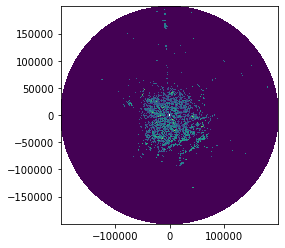
Plot Data
Plot Single Sweep
[45]:
vol[-1].data.pipe(wrl.georef.georeference_dataset).DBZH[0].wradlib.plot()
[45]:
<matplotlib.collections.QuadMesh at 0x7f72c41bec10>
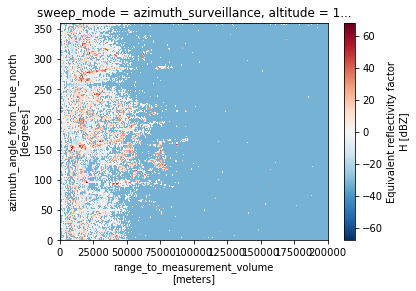
Plot same single sweep from Timeseries
[46]:
vol[-1].data.DBZH[0].plot()
[46]:
<matplotlib.collections.QuadMesh at 0x7f72c40b6610>
Exporting Data
Data can be exported to ODIMH5, CfRadial2 and NetCDF4.
ODIMH5
ODIMH5 can only handle one volume not timeseries. So we have to select the timestep which we want to export.
The example shows, how to output the volume to a ODIMH5-file, read it back and check for equality.
[47]:
vol.to_odim('test_odim.h5', timestep=5)
[48]:
vol1 = wrl.io.open_odim('test_odim.h5')
Open: 100%|██████████| 1/1 [00:00<00:00, 42.00 Files/s]
Collecting: 100%|██████████| 12/12 [00:00<00:00, 3353.21 Angles/s]
[49]:
print(vol[0][5])
<wradlib.XRadSweepOdim>
Dimensions: (azimuth: 360, range: 800)
Elevation: (25.0)
Moment(s): (VRAD, RHOHV, WRAD, DBZH)
[50]:
print(vol1[0][0])
<wradlib.XRadSweepOdim>
Dimensions: (azimuth: 360, range: 800)
Elevation: (25.0)
Moment(s): (DBZH, RHOHV, VRAD, WRAD)
[51]:
xr.testing.assert_equal(vol[0][5].data, vol1[0][0].data)
CfRadial2
CfRadial2 can only handle one volume not timeseries. So we have to select the timestep which we want to export.
The example shows, how to output the volume to a CfRadial2-file and read it back. For there is currently no fitting counterpart to open_odim for reading CfRadial2 volumes we resort to wradlib.io.CfRadial reader and compare the underlying numpy arrays.
[52]:
vol.to_cfradial2('test_cfradial2.nc', timestep=5)
[53]:
vol2 = wrl.io.CfRadial('test_cfradial2.nc', dim0='azimuth')
[54]:
np.testing.assert_equal(vol[0][5].data.DBZH.values, vol2['sweep_0'].DBZH.values)
NetCDF4
Using this, the complete volume/timeseries is exported to a NetCDF4 file.
The example shows, how to output the volume to such NetCDF4-file and read it back. For there is currently no fitting counterpart to open_odim for reading these NetCDF4 volumes we resort to xarray.open_dataset reader.
[55]:
vol.to_netcdf('test_netcdf.nc', timestep=slice(None, None))
Collecting: 100%|██████████| 8/8 [00:00<00:00, 16.93 Timesteps/s]
Collecting: 100%|██████████| 8/8 [00:00<00:00, 17.00 Timesteps/s]
Collecting: 100%|██████████| 8/8 [00:00<00:00, 16.58 Timesteps/s]
Collecting: 100%|██████████| 8/8 [00:00<00:00, 17.39 Timesteps/s]
Collecting: 100%|██████████| 8/8 [00:00<00:00, 16.80 Timesteps/s]
Collecting: 100%|██████████| 8/8 [00:00<00:00, 20.54 Timesteps/s]
Collecting: 100%|██████████| 8/8 [00:00<00:00, 19.86 Timesteps/s]
Collecting: 100%|██████████| 8/8 [00:00<00:00, 31.34 Timesteps/s]
Collecting: 100%|██████████| 8/8 [00:00<00:00, 30.11 Timesteps/s]
Collecting: 100%|██████████| 8/8 [00:00<00:00, 21.72 Timesteps/s]
Collecting: 100%|██████████| 8/8 [00:00<00:00, 20.14 Timesteps/s]
[56]:
vol3 = xr.open_dataset('test_netcdf.nc', group='sweep_0')
[57]:
xr.testing.assert_equal(vol[0][5].data, vol3.isel(time=5))
Delete object
[58]:
del mom
del swp
del ts
del vol
del vol1
del vol2
del vol3
Check Memory
[60]:
mem_end = memory_usage_psutil()
print("Memory: {} - {}".format(mem_start, mem_end))
print("Memory still in use: {0:.5f} MB".format((mem_end-mem_start)))
Memory: 117.921875 - 321.65234375
Memory still in use: 203.73047 MB
Check Open files
No open data files!
[61]:
check_open_files(True)
3
[popenfile(path='/home/travis/miniconda/envs/travis_wradlib/share/proj/proj.db', fd=75, position=40, mode='r', flags=557056), popenfile(path='/home/travis/miniconda/envs/travis_wradlib/lib/python3.8/site-packages/matplotlib/mpl-data/fonts/ttf/DejaVuSans.ttf', fd=78, position=69632, mode='r', flags=557056), popenfile(path='/home/travis/miniconda/envs/travis_wradlib/lib/python3.8/site-packages/matplotlib/mpl-data/fonts/ttf/DejaVuSans.ttf', fd=79, position=69632, mode='r', flags=557056)]