Heuristic clutter detection based on distribution properties (“histo cut”)
Detects areas with anomalously low or high average reflectivity or precipitation. It is recommended to use long term average or sums (months to year).
In [1]:
import wradlib.clutter as clutter
from wradlib.vis import plot_ppi
import wradlib.util as util
import numpy as np
import matplotlib.pyplot as pl
import warnings
warnings.filterwarnings('ignore')
try:
    get_ipython().magic("matplotlib inline")
except:
    pl.ion()
/home/travis/miniconda/envs/wradlib/lib/python3.6/site-packages/h5py/__init__.py:36: FutureWarning: Conversion of the second argument of issubdtype from `float` to `np.floating` is deprecated. In future, it will be treated as `np.float64 == np.dtype(float).type`.
  from ._conv import register_converters as _register_converters
Load annual rainfall acummulation example (from DWD radar Feldberg)
In [2]:
filename = util.get_wradlib_data_file('misc/annual_rainfall_fbg.gz')
yearsum = np.loadtxt(filename)
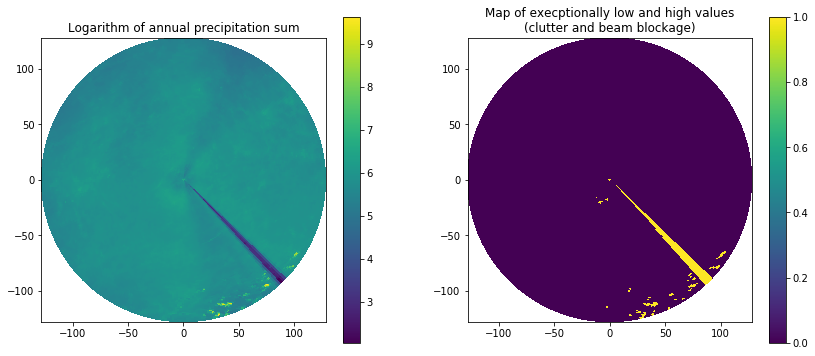
Apply histo-cut filter to retrieve boolean array that highlights clutter as well as beam blockage
In [3]:
mask = clutter.histo_cut(yearsum)
Plot results
In [4]:
fig = pl.figure(figsize=(14,8))
ax = fig.add_subplot(121)
ax, pm = plot_ppi(np.log(yearsum), ax=ax)
pl.title("Logarithm of annual precipitation sum")
pl.colorbar(pm, shrink=0.75)
ax = fig.add_subplot(122)
ax, pm = plot_ppi(mask.astype(np.uint8), ax=ax)
pl.title("Map of execptionally low and high values\n(clutter and beam blockage)")
pl.colorbar(pm, shrink=0.75)
Out[4]:
<matplotlib.colorbar.Colorbar at 0x7f3ef32ae358>